Meursault's death sentence
The Stranger (Albert Camus Edition)Meursault's death sentence is the decisive transformation of his situation from imprisonment into death row. Pronounced in the name of the French people after the jury considers the charge of murder with malice aforethought alongside provocation and extenuating circumstances, it turns a contingent courtroom decision into an irreversible physical future. The sentence also begins the final stage of his confrontation with the legal and social order: the court treats his death as a formal public act, while Meursault experiences its consequences as a solid fact pressing against his body and narrowing his remaining time.
Causes and Background
The sentence follows the closing phase of Meursault's trial. After the arguments, the courtroom waits while the jury considers its answers, and Meursault's lawyer reassures him that the result will probably be favorable. The lawyer expects a few years of imprisonment or transportation and admits that there is no realistic prospect of having the judgment quashed, since he has not raised a point of law and technical grounds would be difficult to establish. He nevertheless says that Meursault can appeal in the ordinary way and remains convinced that the verdict will be favorable. This confidence establishes the gap between legal expectation and the decision that follows.
The jury is asked to respond to a rapid series of questions, including whether the killing involved malice aforethought, whether there was provocation, and whether extenuating circumstances applied. The questions reduce the event to legal categories whose arrangement will determine Meursault's fate. Once the jury has withdrawn, he waits for the formal reading of its answers and the judgment. The procedure gives the appearance of orderly deliberation, yet the personal consequences are concentrated entirely upon him; the waiting courtroom is a collective scene organized around an outcome that, in practical terms, concerns only the accused.
What Happens in Court
After roughly three quarters of an hour, a bell rings and the lawyer leaves Meursault to explain that the foreman will read the jury's answers before Meursault is called back to hear the judgment. Doors slam, people hurry down the stairs, and a voice drones from the courtroom. The sounds make the verdict perceptible before its words arrive, turning the legal process into a sequence of signals, pauses, and bodily waiting.
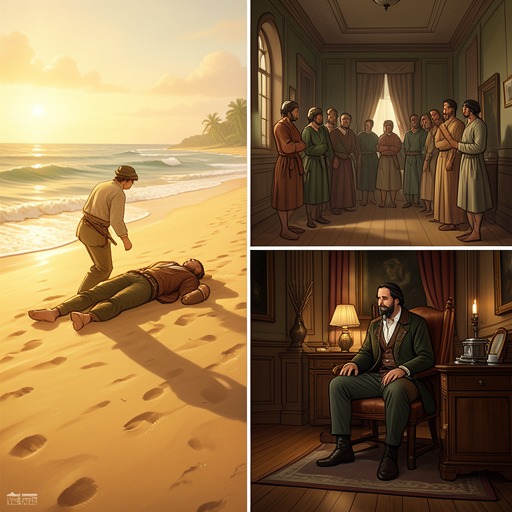
When the bell rings again, Meursault returns to the dock. The courtroom falls silent, and he notices that the young journalist, who had watched him during the hearing, now keeps his eyes averted. The presiding judge pronounces a formula stating that, in the name of the French people, Meursault is to be decapitated in a public place. The sentence is therefore not merely imprisonment or an abstract declaration of guilt: it specifies execution by decapitation and assigns that execution a public setting, making state violence both legal judgment and social spectacle.
The people present seem to Meursault to wear expressions of almost respectful sympathy. The policemen handle him gently, and his lawyer places a hand on his wrist. These gestures do not soften the sentence; instead, their gentleness contrasts with the brutality of the announced punishment. The judge asks whether Meursault has anything more to say. After a moment's thought, he answers, “No.” The policemen then lead him away, and the brief reply marks the end of his participation in the courtroom's language: the institution has spoken, and he offers no further defense.
Immediate Consequences
The verdict produces a new kind of confinement. Meursault has already spent time in prison, but after the death sentence the prison becomes the last stage before execution rather than a temporary interruption of ordinary life. He has previously hoped that something agreeable might happen, and during the early days he was scarcely conscious of being in prison. That possibility ends after Marie's first and only visit, when a letter informs him that she will no longer be allowed to visit because she is not his wife. From that point, the cell becomes his “last home,” a dead end with no ordinary future beyond it.
The penal system controls him through small bodily privations as well as through the sentence itself. On entering prison, he loses his belt, shoelaces, pocket contents, and cigarettes. Smoking is forbidden, and the deprivation initially causes intense physical distress: he feels faint and bilious and even sucks splinters from his plank bed. Later he understands that the ban on cigarettes is itself part of the punishment; by then, however, the craving has disappeared, showing how punishment can lose its intended force once the prisoner adapts to it. A jailer explains the broader logic of imprisonment by defining liberty as precisely what Meursault has been deprived of. The sentence makes that principle fully concrete: the loss of freedom is now joined to the certainty of death.
Death Row and the Search for a Loophole
After the sentence, Meursault is moved to another cell where he can see the sky and little else. He spends his time watching its colors change as day moves into night, lying on his back with his hands behind his head and waiting. This narrowed field of vision gives the sentence a temporal form. The changing sky is one of the few movements left to him, while the execution remains an approaching event that structures every moment.
Meursault repeatedly searches for a loophole in what he calls the implacable machinery of justice. He imagines condemned prisoners escaping at the last moment, breaking through the police cordon, or disappearing before the guillotine falls. He regrets never having paid closer attention to accounts of public executions or sought technical books that might contain stories of escape. Even one instance in which chance interrupted the sequence would satisfy him, because it would prove that the apparently inexorable process could be broken. His imagined alternative is not a confident plan but a final gamble: a dash for freedom that might end in capture or a bullet in the back, yet would still provide a moment of hope.
The sentence becomes unbearable to him because of the disproportion between the judgment and the unalterable chain of consequences that follows it. He considers that the verdict might have been delivered at eight in the evening rather than five, that it might have been different, and that it was attributed to the vague collective entity of the French people. Such contingencies seem to weaken the judgment's moral gravity. Yet once pronounced, the verdict acquires an undeniable material force. Its effects are as tangible as the wall against which Meursault lies, so the sentence is simultaneously arbitrary in origin and absolute in consequence.
Narrative Significance
Meursault's death sentence completes the novel's movement from legal uncertainty to existential certainty. The court attempts to establish a stable meaning for the killing through categories such as malice, provocation, and mitigation, but the sentence exposes how an institution converts those unstable interpretations into a fixed fate. The legal order speaks with collective authority, yet the condemned man experiences that authority through concrete restrictions: a cell, a controlled body, a lost visitor, forbidden cigarettes, and the anticipated guillotine.
The event also changes the meaning of hope. Before the verdict, hope belongs to the ordinary language of appeals, acquittal, imprisonment, or transportation. Afterward, hope survives only as the imagined possibility of a last-minute accident or escape. Meursault's attention shifts from legal argument to the mechanics of execution and from social judgment to the passage of time beneath the sky. His silence when asked whether he has anything more to say is not a successful challenge to the court, but it confirms the radical narrowing of his position: the institution has fixed his future, and he can only observe the force with which that future bears down upon him.